In a rapidly changing professional world, choosing the right college is about more than earning a degree. Students need an educational environment that helps them develop analytical thinking, communication, technical knowledge, leadership, and the confidence to approach real-world challenges.
Aditya Institute of Management Studies and Research (AIMSR), Mumbai, has focused on management and professional education through programmes designed for students with different academic and career aspirations. The institute’s current website presents it under the name Aditya Institute of Management Technology and Research (AIMTR), previously known as AIMSR. Its academic offerings include management, computer applications, and doctoral research.
For students exploring higher education in Mumbai, understanding the available programmes and learning opportunities can help them choose a path that aligns with their long-term goals.
1. A Range of Programmes for Different Career Goals
One of the important considerations when choosing a college is whether its academic programmes match a student’s interests and previous qualifications.
The institute’s published website highlights the following programmes:
| Programme | Main area of learning | Suitable for students interested in |
| Bachelor of Management Studies (BMS) | Business fundamentals and management | Undergraduate business education |
| Master of Management Studies (MMS) | Management, strategy, and leadership | Advanced business and managerial roles |
| Master of Computer Applications (MCA) | Computing and technology | Software, IT, and technology-related careers |
| Ph.D. in Management Studies | Advanced research | Academic, research, and specialised professional pathways |
Each programme serves a different purpose. Students should review the latest course structure, eligibility requirements, admission process, and applicable approvals before applying.
2. Build a Strong Foundation in Business Management
Business management involves understanding how organisations plan, operate, communicate, and grow. Students interested in this field need to become familiar with areas such as marketing, finance, organisational behaviour, human resources, and strategic decision-making.
The BMS programme can introduce undergraduate students to these business fundamentals, while the MMS programme provides postgraduate-level management education.
Learning about different business functions helps students understand how departments work together to achieve organisational objectives. It can also support informed decisions when selecting a specialisation or exploring future career options.
3. Connect Academic Concepts with Practical Applications
Management and technology professionals regularly encounter problems that cannot always be solved by memorising information. They must evaluate evidence, compare possible solutions, and communicate their reasoning.
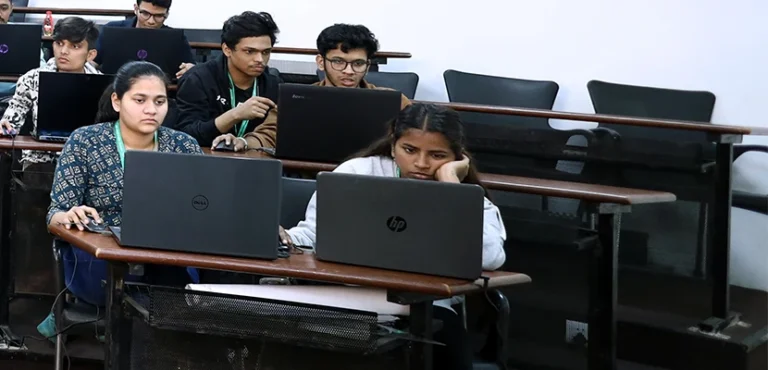
AIMSR’s published academic information highlights learning approaches such as case studies, projects, internships, mentoring, guest lectures, and industry interactions. These activities can help students connect academic concepts with practical situations.
For example, a business case study may require students to assess a company’s marketing strategy, while a technology assignment may involve designing or evaluating a software-based solution.
Practical learning is most valuable when students actively participate, reflect on feedback, and use what they learn to improve their work.
4. Develop Skills Relevant to a Technology-Driven Economy
Technology is influencing business operations across industries. Organisations increasingly rely on digital systems, data, software, and emerging technologies to improve services and make decisions.
The MCA programme is relevant to students interested in computer applications and technology-oriented careers. Depending on the curriculum and electives, students may explore programming, databases, software development, and related computing concepts.
For management students, understanding technology can also be useful. Modern professionals often work with digital platforms, business information systems, and data-supported decision-making processes.
Combining technical understanding with communication and problem-solving skills can help graduates adapt to changing workplace requirements.
5. Strengthen Communication, Leadership, and Teamwork
Professional competence includes both subject knowledge and the ability to work effectively with others.
Presentations, group assignments, discussions, and collaborative projects can give students opportunities to practise explaining ideas, listening to different viewpoints, dividing responsibilities, and managing deadlines.
Leadership development is especially relevant for management students, who may eventually coordinate projects, supervise teams, or contribute to strategic decisions.
Students can strengthen these abilities by participating in campus activities, seeking feedback from faculty, and taking responsibility for their academic and extracurricular commitments.
6. Explore Research and Independent Thinking
Research is important for improving existing knowledge and examining new questions. It encourages students to investigate evidence, identify gaps, evaluate information, and develop well-supported conclusions.
The institute’s website lists a Ph.D. programme in Management Studies for eligible candidates interested in advanced research.
Doctoral research can be suitable for individuals who want to explore management questions in depth, contribute to academic knowledge, or pursue research-oriented professional opportunities. Applicants should check the current eligibility criteria, entrance requirements, research guidelines, and availability of seats with the institute and relevant university.
Even students pursuing undergraduate or postgraduate programmes can benefit from developing research skills, particularly when completing projects and evaluating business or technology problems.
7. Explore Potential Career Pathways
The career options available to graduates depend on their qualification, specialisation, skills, experience, and the requirements of employers.
Potential pathways include:
- After BMS: Marketing executive, business development associate, management trainee, or further study in management.
- After MMS: Opportunities in marketing, finance, human resources, operations, business development, or management-related functions.
- After MCA: Software development, application support, IT services, database-related roles, or other technology positions, depending on technical proficiency.
- After a Ph.D. in Management Studies: Academic teaching, research, consulting, or specialised research roles, subject to relevant qualifications and recruitment criteria.
These are examples rather than guaranteed outcomes. Students should assess the programme curriculum, practical experience, placement support, and their own career interests when planning their next steps.
8. Make the Most of the Mumbai Learning Environment
Mumbai is home to businesses across financial services, technology, media, retail, consulting, and other sectors. Studying in this city can give students a useful context for understanding different industries and professional environments.
Industry events, internships, guest sessions, and professional networking can complement classroom learning when opportunities are available.
Students can make the most of their college experience by attending relevant events, building relationships with peers and faculty, improving their resumes, and exploring internships aligned with their goals.
9. Check Admission Requirements Before Applying
A well-planned admission process begins with selecting the right programme and checking its eligibility criteria.
AIMSR’s website provides programme information and admission notices, including notices for the 2026–27 academic year. Admission procedures and requirements may differ between BMS, MMS, MCA, and doctoral programmes.
Before submitting an application, prospective students should:
- Confirm the programme’s current name and duration.
- Check the academic eligibility criteria.
- Review applicable entrance examination and admission procedures.
- Understand the fee structure and required documents.
- Verify current institutional status, programme approvals, and university affiliation.
- Contact the admissions office if any information needs clarification.
For the most accurate details, consult the official website at https://www.aimsr.edu.in/.
Conclusion
Choosing a college is an important decision that can influence a student’s academic development and professional direction. A strong educational experience should provide relevant subject knowledge, opportunities for practical learning, communication skills, and the ability to keep learning as industries evolve.
AIMSR, now presented on its official website as Aditya Institute of Management Technology and Research (AIMTR), offers academic pathways in management, computer applications, and management research. Students considering the institute should compare the available programmes carefully and confirm current admissions information before making a decision.
By selecting a programme that matches their interests and making active use of learning opportunities, students can build a foundation for continued education and future professional growth.
Frequently Asked Questions
1. What is AIMSR Mumbai?
AIMSR stands for Aditya Institute of Management Studies and Research. Its current official website identifies the institution as Aditya Institute of Management Technology and Research (AIMTR), previously known as AIMSR.
2. Which courses are highlighted on the institute’s website?
The website lists Bachelor of Management Studies (BMS), Master of Management Studies (MMS), Master of Computer Applications (MCA), and Ph.D. in Management Studies.
3. What is the difference between BMS and MMS?
BMS is an undergraduate programme that introduces students to business and management. MMS is a postgraduate programme focused on developing more advanced management knowledge and capabilities.
4. Who should consider an MCA programme?
Students who meet the current eligibility requirements and want to develop knowledge of computer applications, software, and related technology fields may consider MCA.
5. Does the institute offer doctoral research in management?
The official website lists a Ph.D. in Management Studies. Prospective applicants should verify current eligibility, entrance requirements, research guidelines, and seat availability.
6. How can students learn about the admission process?
Students should visit the official website and review the latest admission notices, programme-specific criteria, and instructions for their chosen course.
7. What should students consider when choosing a programme?
Students should compare curriculum, eligibility, fees, practical learning opportunities, faculty, career pathways, and current programme approvals or affiliations.
8. Where can students find official information?
Visit https://www.aimsr.edu.in/ for the institute’s current programme details and admission announcements.